AI-Native SaaS Architecture: The 2026 Blueprint
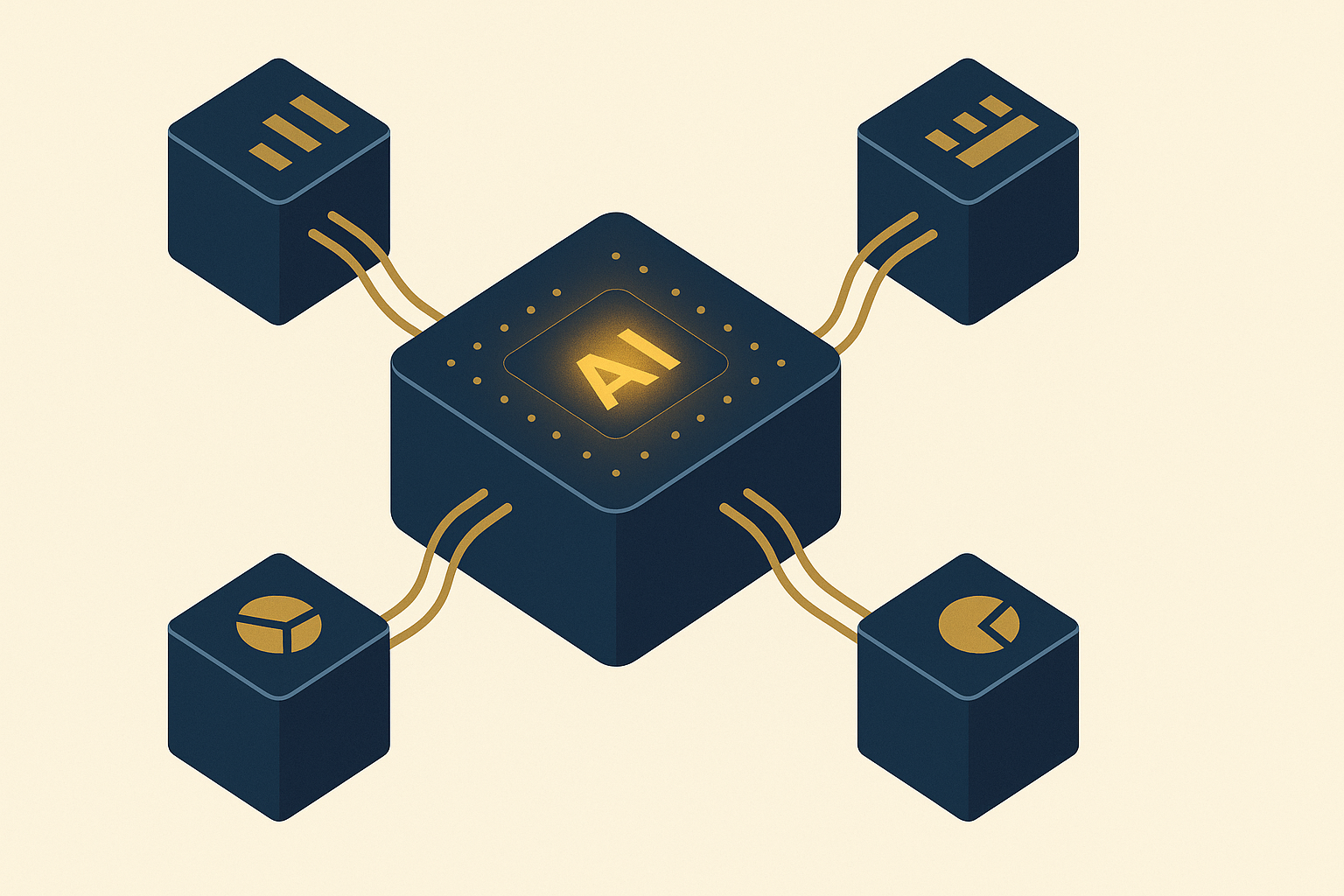
AI native SaaS architecture is a design where real-time data, backend AI, and open protocols replace the request-response monolith. Rather than bolt a chatbot onto an old stack, you rebuild the system around three pillars: live data by default, AI treated as a controlled component, and services distributed through protocols such as MCP.
Why the traditional SaaS monolith runs out of road
For years the pattern held steady: a web UI, an API, a backend, a database, a few integrations. That stack shipped a generation of products.
It is now the bottleneck.
None of it is fashion. Three forces (real-time expectations, unreliable model output, and distribution beyond the browser) each break a different assumption the old design was built on. Add an OpenAI or Claude call to a legacy backend and you have a chatbot, not an architecture. This is the shift we help clients design, and the blueprint below is how we think about it.
Picture the monolith at work. Someone acts, the app asks the server, the server replies. Clean, and increasingly inadequate.
Users stopped tolerating static screens. New messages, payment states, tickets, bookings, application statuses: people expect these to appear without a refresh.
AI is the second crack. Language models are non-deterministic by nature. They can reply in the wrong format, forget a rule, emit broken JSON, or read an instruction in a way you did not plan for. Your backend, which quietly assumed clean and predictable responses, now has a wildcard sitting in the middle of it, and every downstream step inherits that uncertainty unless something catches it first.
Distribution is the third crack. Modern services exist in more than one place: browser, mobile, WhatsApp, email, CRM, Slack, internal dashboards, ChatGPT, autonomous agents. The web page is one surface among many.
Put together, a modern SaaS product is no longer a web app. It is a distributed, reactive, agentic system, and it needs foundations to match:
| Layer | Traditional monolith | AI-native stack |
|---|---|---|
| Data updates | Polling or hand-built WebSockets | Reactive push (~20 to 50 ms) |
| AI output | Trusted blindly | Schema-validated, retried, fenced |
| Distribution | One web page | Web, ChatGPT, agents, messaging |
| API secrets | Often leak to the client | Server-only, proxied |
| Deployment | Docker, Kubernetes, DevOps | Serverless functions |
Real-time becomes the floor, not a feature
In a classic app, data is fetched on demand. You load a page, click, or refresh to see what changed. That model is aging out.
Data should behave like a live stream. The interface reacts to change on its own.
This is where a reactive backend such as Convex earns attention. It folds the database, the backend logic, real-time delivery, type validation, and file storage into one layer: the pieces a traditional stack keeps apart and wires together by hand.
In that world a call like useQuery does more than fetch a row. It subscribes the client to a stream. When the underlying value changes, the UI updates itself, typically within 20 to 50 milliseconds. We walk through the mechanics in real-time data with Convex.
Build the app as a living system, not a dead page wired to a static table. That goal is easy to say and hard to fake.
Bolting an LLM onto your backend is a slow-motion outage
Here is the mistake almost everyone makes first. Take a normal backend, add one call to a model, and hope a clean response comes back.
It works in the demo and breaks in production.
Your backend cannot depend on an answer that is vague, fragile, or unpredictable, especially when that answer will open a ticket, route a request, summarize a document, or change stored data. The problem is rarely the model itself. What is missing is the reliability pipeline around it, and without that scaffolding even a strong model becomes a liability the first time it improvises.
Naive integrations share a signature: an overlong prompt, useless context, no strict schema, a blind wait for valid JSON, no error handling, no output check, no fallback. The result is broken parsing, silent misclassification, and the occasional backend crash at 2 a.m.
To run AI in production, treat it as a controlled component with guardrails, closer to a database query than a chat window.
A five-step pipeline for reliable backend AI
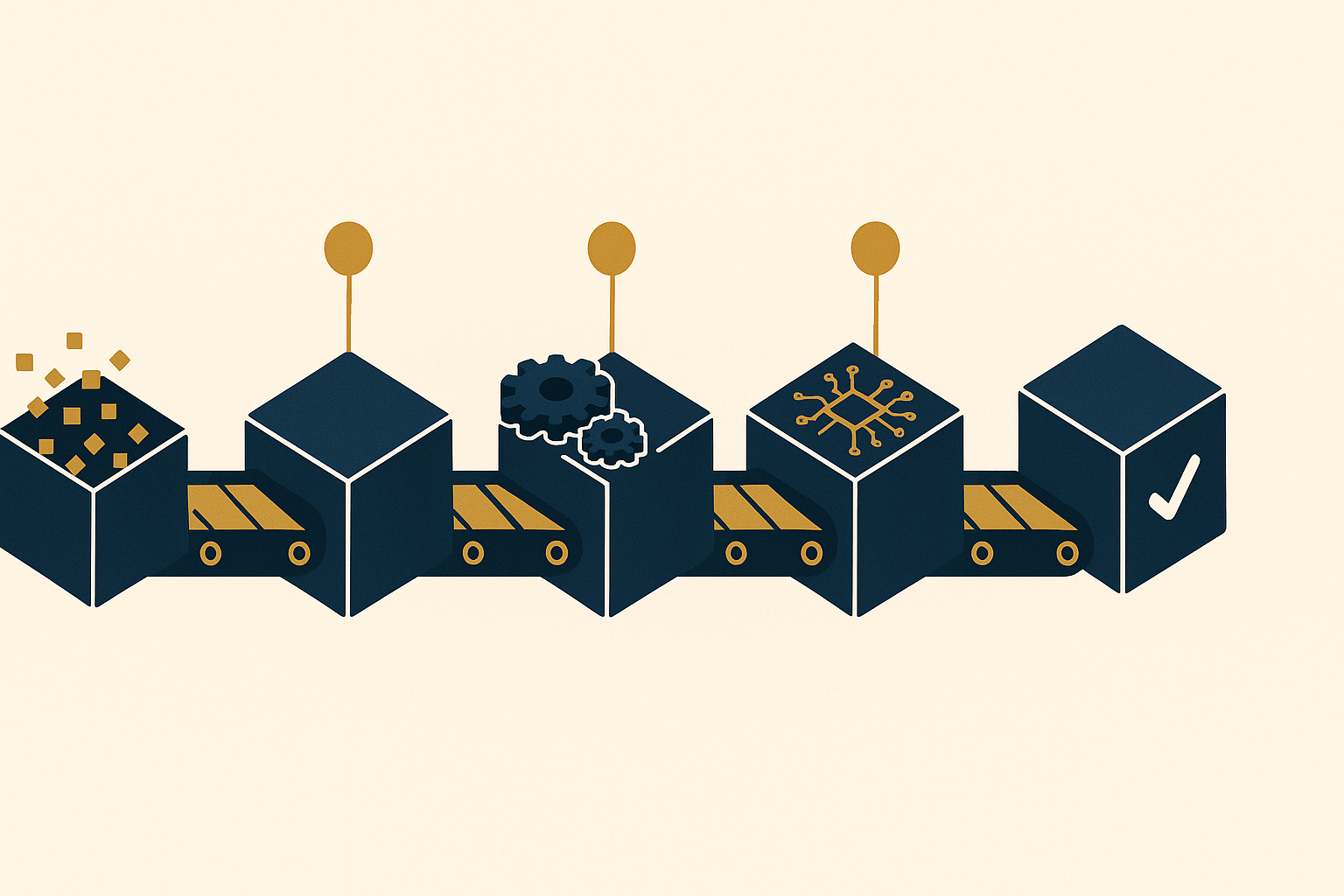
Reliable model integration comes from discipline between the user's input, the model, and the output your backend can actually use. Any pipeline that holds up in production has five stages:
- Validate the input. Filter every incoming request through a strict schema (Zod is the common pick) so malformed or hostile data never reaches the model.
- Write a tight prompt. Keep it short and explicit, stating the exact output shape with one or two examples, instead of a wall of context the model has to wade through.
- Wrap the call. Put retries, backoff, a sane timeout, and logging around the SDK call so a single slow response never stalls the whole request.
- Validate the output. Re-check the model's JSON against the same schema before anything downstream touches it: the model is a guest, not a trusted subsystem.
- Add a circuit breaker. After repeated failures, escalate to a fallback: a classic code path, a queue, or a human review step, rather than retrying into the void.
That structure turns a flaky call into a component you can build on. It also tells you where AI belongs:
- Parsing messy inbound text into tickets, pulling customer, urgency, and product out of a raw email, then validating the fields before the ticket is created.
- Short, auditable summaries for logs, notifications, or long threads, kept traceable.
- Intent routing, classifying a request and sending it to support, billing, or sales in milliseconds. We break this down in how agentic AI automates lead qualification.
Use AI where it removes real friction, not because it looks impressive on a demo.
MCP and ChatGPT Apps: your software goes where users already are
Distribution is the other shift, and it moves fast.
Custom GPTs let people build assistants with instructions, files, and a few API actions, but the interaction stayed mostly textual. The newer model goes further. At its DevDay in October 2025, OpenAI launched Apps in ChatGPT and the Apps SDK, turning the chat window into a software channel where widgets, data cards, filters, and multi-step flows render inline. Early partners included Booking, Canva, Expedia, Figma, Spotify, and Zillow, each rendering a real interface rather than plain text.
That matters because of reach. ChatGPT passed 900 million weekly active users in February 2026, up from 800 million the previous October. Your app can meet those users without an app store, and they never leave the conversation to use it.
Underneath sits the Model Context Protocol (MCP), an open standard Anthropic released in November 2024 and later handed to a Linux Foundation body. MCP organizes the connection between a model and your systems around three things:
- Tools, functions the model can run: search a hotel, open a ticket, query a database.
- Resources, data and interfaces the backend serves, including HTML widgets and structured records ready to render.
- Prompts, the system instructions and examples that fence the model's behavior.
Its payoff is one standardized server that speaks to the whole model ecosystem, instead of a bespoke, brittle integration per model. Adoption moved quickly, and the MCP registry crossed roughly 2,000 servers by its first birthday. As OpenAI's Srinivas Narayanan put it:
"MCP is now a key part of how we build at OpenAI, integrated across ChatGPT and our developer platform." Srinivas Narayanan, CTO of B2B Applications, OpenAI

The stack in practice: Next.js, Convex, Clerk, MCP, Claude
These pillars map onto a concrete set of parts:
- Next.js as the orchestrator, hosting the UI, the server routes, the MCP server, and the distribution logic in one deployable app.
- Convex as the real-time database and reactive backend, handling queries, mutations, types, transactions, and file storage without a separate ORM to babysit.
- Clerk for authentication and identity: in a distributed system, this is the layer that isolates each user's data and gates access.
- MCP as the connective tissue between the app and the models, exposing tools, resources, and prompts in a structured frame.
- Claude Code on the semantic backend, doing the constrained work of parsing, generating, and transforming information inside the reliability pipeline above.
None of these is mandatory. What matters is the shape they form together: real-time, secured, agentic, and distributed.
Security and the three laws of the AI-native app
As a system gets more distributed, its attack surface grows. Agents, external tools, API calls, widgets, and multi-channel hooks each add exposure. Two rules stay non-negotiable.
Third-party API keys never reach the frontend. They live in server environment variables, and the backend acts as the proxy that validates each request and holds every permission. A key that ships to the browser is a key an attacker can read, and from there drain a paid AI account or wipe a database, which is why we argue the point in full in why your frontend code isn't a vault.
Data stays isolated per user. With Clerk and Convex, the backend verifies identity through a JWT and enforces strict access rules, so no client (and no agent acting on its behalf) can reach data it does not own.
Underneath all of it sit three laws worth stating plainly:
- Reactivity is not optional. If a user has to refresh to see an update, the architecture is already behind.
- AI is a system component. Models must be constrained, validated, routed, and observed with the seriousness you give a SQL database.
- The interface travels. The browser is one destination; think in portable tools and resources that run inside ChatGPT, dashboards, agents, and internal workflows.
What this means for SaaS in 2026
SaaS in 2026 will not simply be "AI-powered." It will be real-time, agentic, secured, interoperable, and distributed, built on backends that hold AI to account instead of hoping for the best.
Teams that only staple a chatbot to an existing product are shipping a thin layer. Teams that rebuild around live data, reliable model integration, and open protocols are shipping something that lasts.
Adding AI to your app is no longer the hard part.
The hard part is designing a system where AI, data, users, and interfaces hold together without breaking. That is the transition builders, agencies, and product teams have to work out now, and it is exactly the kind of system we design and build. If you have a SaaS idea or an internal workflow you want reshaped this way, tell us what you're building.
Frequently asked questions
It is a design where real-time data, backend AI, and open protocols are foundational rather than bolted on. The app is rebuilt around live data, AI treated as a validated system component, and services distributed through protocols like MCP.
It assumes static pages, manual refreshes, and a single web destination. Modern products need live updates, non-deterministic AI kept under control, and a presence inside tools like ChatGPT, Slack, and CRMs, not just a browser tab.
Large language models are non-deterministic. They can return invalid JSON, drop a constraint, or answer in an unexpected shape. Reliability comes from schema validation, retries, timeouts, and a circuit breaker around the model, not from trusting its output.
The Model Context Protocol, released by Anthropic in November 2024, is an open standard that connects models to tools, resources, and prompts. It lets one server implementation serve ChatGPT, Claude, and other models, and it powers Apps in ChatGPT.
Convex unifies the database, backend, and real-time layer. A query subscribes the client to a live stream, so the UI updates automatically when data changes (usually in 20 to 50 milliseconds) without manual WebSockets or polling.
No. Most teams start with one high-friction workflow, such as email-to-ticket parsing or intent routing, then wrap it in a reliability pipeline, and expand from there. The shift is architectural, but it can be adopted one surface at a time.
Ready to automate the work?
Media Targeters builds custom agentic AI systems that run your operations while you focus on growth.
Book a discovery callRelated Articles
Why Agentic AI Projects Fail (5 Questions First)
Gartner expects over 40% of agentic AI projects canceled by 2027: not weak models, weak governance. Five questions predict which ones survive.
AI Agents vs Agentic AI: What's the Difference?
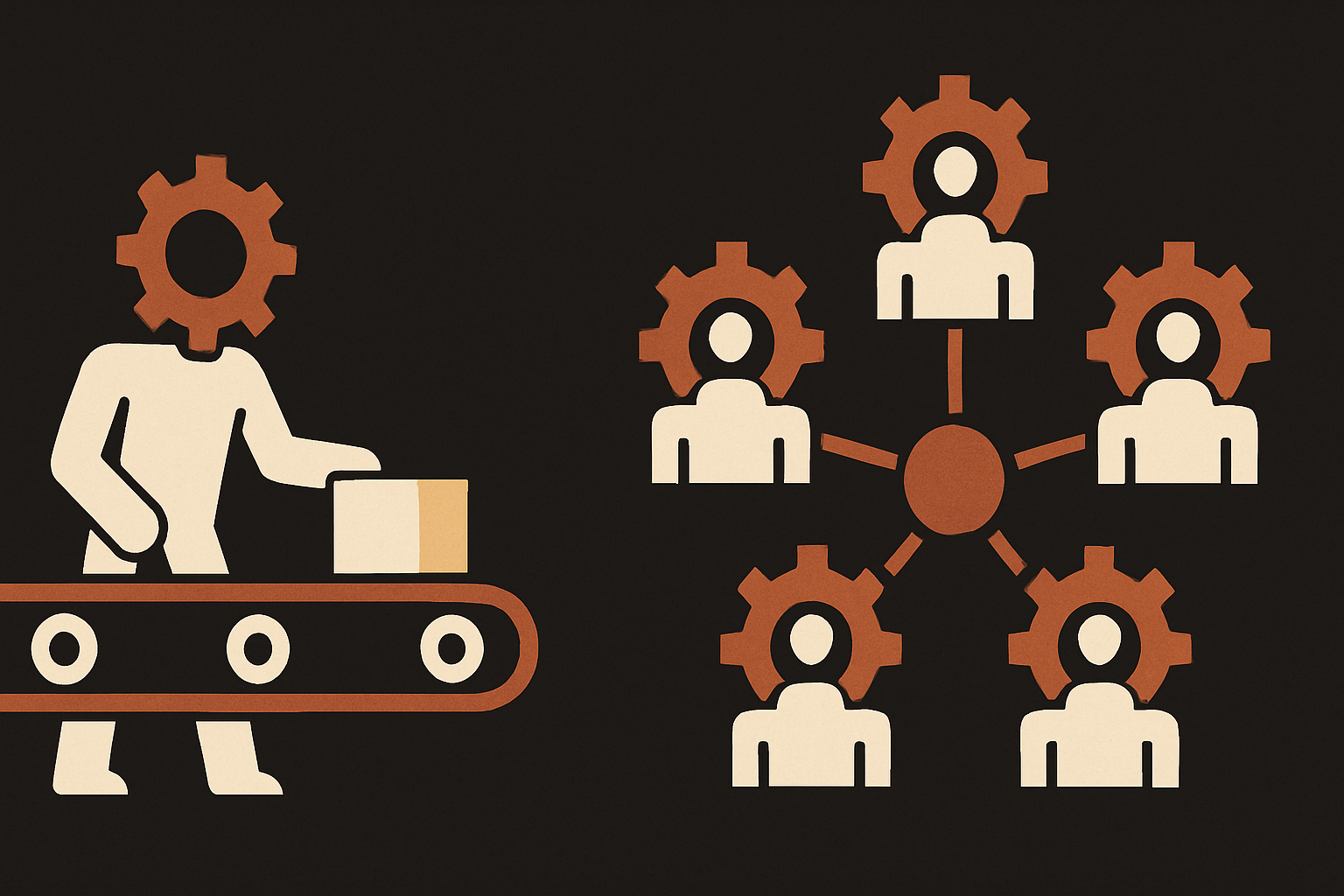
AI agents handle single tasks; agentic AI orchestrates them toward goals. Get the real difference, a side-by-side table, and which one your business needs.
How Agentic AI Automates Lead Qualification
See how agentic AI automates lead qualification end to end (scoring, enrichment, and instant follow-up) and the metrics that prove it pays off.

Morocco Real Estate 2026: Boom, Crash, or Neither?
Is Morocco's real estate market booming or crashing in 2026? Bank Al-Maghrib data shows a 40% Q1 transaction drop, but the yearly picture is milder.